Published on Thursday, 26 Mar, 2026
Leading through challenging times
 Sally Lait
In my career I’ve seen a wide range of what could generically be considered “challenging times”: layoffs, a pandemic, complete C-suite overhauls, political instability and wars, reorgs and strategic U-turns, and more.
As a manager and leader, one of the most difficult things to do can be supporting a team of others through a tough challenge, whilst you’re also processing and being affected by it yourself. Some examples that I’ve seen people struggle with are trying to lead both affected and unaffected folks through layoffs when your role is also at risk, or leading through a war when you and your reports are worried about family based in an affected country.
Very often these events come come out of the blue, and if you haven’t had to balance both yourself and other people before, it can be extremely difficult to wade through everything. In this post I want to outline some of the key recommendations and reflections I’ve found useful with various teams and situations in the past.
Note that I also offer a workshop version of this post, to run with teams and leaders facing challenges – please get in touch for more information
1️⃣ Putting on your own oxygen mask first, before jumping to help others
Some people work through crises to distract themselves, but before you do so I’d recommend initially focusing on yourself, so that you can then help others effectively. You’ll be no good to your team if you push through, and unexpectedly fall apart at a time you weren’t expecting to.
Understanding what you’re feeling, and how that’s likely to change over time
As a leader and manager, it can be damaging if you don’t realise you’re feeling a certain way, and that bleeds out unexpectedly.
By using tools such as the Feelings Wheel (version here by Calm) you can work through and assess the nuances. Maybe you’re feeling fearful for the future, but by drilling deeper into understanding that driving this is that you’re feeling ’overwhelmed’, it can help you take more tailored action than if for example you were feeling ‘inferior’ or ‘inadequate’.
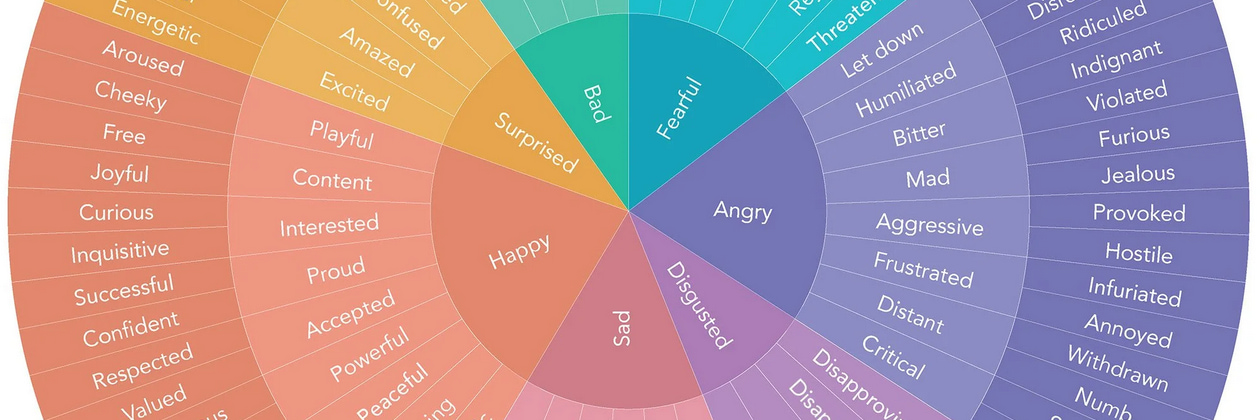
An important point to note is that your feelings will likely change over time, especially if you’re going through a process like consultation around redundancies where there are multiple notable milestones, each of which may individually move people forwards or backwards with their processing.
A useful visualisation for typical stages of emotion is the Kübler-Ross Change Curve, which is builds on the model of the five stages of grief – denial, anger, bargaining, depression and acceptance. Whilst the below is a typical process, in reality everyone’s experience will be slightly different.
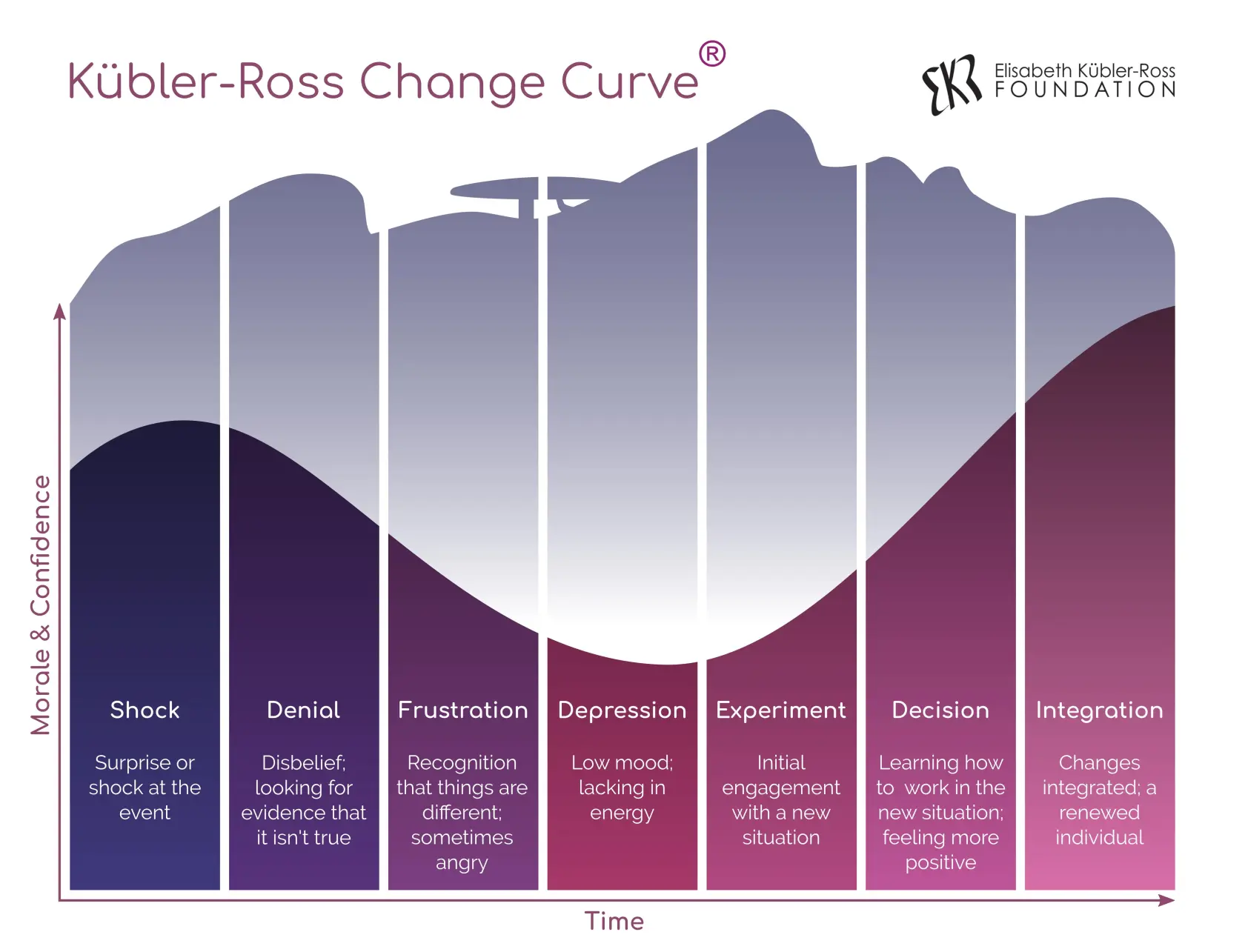
Some key points to bear in mind include:
- Understanding you can “roll back” on the curve, and that it may take time to work through everything. Be careful if you think you “skipped” a stage and are safe from it!
- Be kind to yourself but don’t let yourself get stuck. Particularly when you hit phases like depression or anger, it can be easy to stay in them for longer than is healthy.
- Check in with yourself often, self-awareness is key to navigating this well.
- The end state may look different to what you’re anticipating now. It won’t necessarily be the same as before everything started, and it may not be what you would have expected… but that can still be ok.
What’s driving these feelings, and what factors may be at play that you hadn’t noticed?
When it comes to the workplace, a very useful reference is BICEPS by Paloma Medina. In this, Medina outlines how Belonging, Improvement, Choice, Equality/ Fairness, Predictability, and Significance impact on us.
“There are six core needs researchers find are important for humans (both at work and in our personal lives). Each of us have a personal hierarchy for the six however: You might find that equity and belonging are most important to you, but choice and status are most important to your employee, your partner, your child. Getting to know them is a shortcut to better communication, as well as greater inclusivity at work.”
For example, if you’re someone who places a large amount of emphasis on “belonging” and “predictability”, having your entire team upended through layoffs is going to be driving some of the emotions you’re facing.
On a more personal level, it’s also worth considering the other factors that may be feeding some of your emotions, or helping you to see how stresses may be displaying.
- When did you last leave the house? How much sunlight and vitamin D are you getting?
- Have the length of your workdays changed?
- How do your patterns around food/water/sleep/hobbies/head space compare to normal?
- What would you normally be doing to unwind? How does the current situation differ, and what’s the impact on you?
- In normal times what gives you energy, and what drains you? How much of each are you getting at the moment?
- When did you last take holiday, and how long for? Are you running on empty even before this challenge?
- What are you finding difficult to do? How does this compare to what you normally find difficult?
What can you control, influence, or neither?
Now you hopefully have a bit of a better grasp of what’s going on, I’m afraid we’re at the tough love bit. Contrary to what you may believe, you almost certaintly can’t effectively support others or lead when you’re in a bad place. After assessing everything I’ve laid out above, you’re going to need to be honest with yourself: can you work through this, stay in control, and do a great job? Or would you be better stepping away (even for a very short period)?
Being in a leadership position, you may feel that the expectation is that you need to ride everything that gets thrown your way, and never show any kind of “weakness”. However in reality we all need to choose where to spend our finite energies. Sometimes, being brave, stepping away, and then coming back stronger will serve everyone better overall. That might take the form of cancelling some 1:1s so that you can really focus on planning an effective all-hands meeting, taking a day to step away from your screen, or asking for someone’s help to handle your responsibilities. It will reflect a lot better on you if you take a day to gather yourself, rather than pushing through and doing some damage (your sphere of influence and blast radius can be larger than you realise).
Not everyone is experienced at, in a personal place to deal with, or good at this kind of crisis work. Outside of yourself, you may also need to encourage others to do similar. Consider treating this time like a relay race; each person handing over the baton when they need, to try to optimise for the best outcomes generally – balancing individuals, teams, and the business overall.
Tied into this is being able to pick your battles. For example with layoffs, you may not be able to control whether they’re happening full stop. This is likely a waste of your energy. However, depending on your position, you may well be in a position to influence outcomes, whether your own or your team’s.
It can help to understand your challenges and frustrations through the lens of “control, influence, or neither”, and to focus your energies on what will have most impact. For example:
- I can control making sure that I’m drinking enough water, and not having my phone near my bed at night.
- I can influence my team feeling that they are valued and respected.
- I can influence by sharing a business case to highlight the importance and impact of someone’s role, which may not have been assessed accurately.
- I have neither control nor influence that there is a war occurring, and that I do knot know if or when it will end.
Taking action for yourself
If you’re a planner, (which let’s face it, as a manager/leader you likely are), it can help to get everything down into a structured form. Consider pulling together an action/wellbeing plan including:
- What does wellbeing look like for me, and what do I need to do that keeps me well every day?
- What tools do I have to boost or control my wellbeing? (e.g. What can you change about your environment? What about your routine? Can I access a therapist?)
- What are my early warning signs for if I’m handling everything poorly? Who can I trust to flag this to me honestly?
- What are triggers for me, and what can I do about them?
- Who and where can I get support from? What help can I ask for?
- If this was a physical injury would I still be working?
- What is worrying me that I can control, what can I influence, and what do I need to accept and let go?
- What can you commit to doing tomorrow that’ll make it better than today?
2️⃣ Supporting your team and others around you
Now that you’re hopefully a bit more in deliberate control, it’s time to think about supporting others through the challenging time.
What you actually do will depend a lot on the situation you’re experiencing – for example leading through political turmoil may be a lot more about understanding, listening, facilitating time off, setting expectations about communication. Layoffs or a pandemic may have more emphasis on topics like org design, logistical arrangements, and assessments.
It’s also important to note that on some occasions, you may have had more of a heads up than others, and as such may be ‘further along’ on the change curve. For example maybe you found out last month that there would at some point be major C-suite changes, and have been able to prepare your own feelings. If so, bear in mind that your team won’t be on the same wavelength as you, and you shouldn’t expect them to be.
Regardless, some of the constants that I would recommend include the following:
Asking your team how they are, and what they need
To do this you can use some of the exact same tools that I shared with you above. If, for example, you’re seeing that there’s a lot of uncertainty and shock, maybe you need to increase the level of communication and hold Q&A sessions. Can you share information in multiple formats to help people absorb it more effectively?
Sharing your own feelings
Being vulnerable, and sharing what you’re worried about or doing to improve your situation, can help encourage others to recognise challenges and get support too. However it’s very important that this stays at an appropriate level. Inside you may not have everything together and could be completely freaking out, but others will be looking to you for reassurance. Instead, make sure you’ve got the support to vent in other channels, and sharing your somewhat calmer “I’m finding this tough but we’ll get through it” exterior… or again, take a step away if you can’t do so

Understanding that the dynamics on teams may change over time
As with an individual on the change curve, major challenges will similarly play out with different levels of productivity within teams over time. As a leader, some of the things that you can do to support this:
- Set out your expectations of the team – is everything carrying on as normal and all previous deadlines stand? Will there be an org-wide break for people to process? What is changing and what isn’t?
- You may want to consider reassessing and reiterating priorities
- Tracking team energy levels and dynamics will help to flag any potential risks – using techniques such as Team Health Checks can help here
- Encouraging people to do a calendar defrag in line with any changing priorities, making sure there’s enough time, space, and positive energy to focus on the most impactful tasks.
- Recogise and support those who want to stay busy and distracted.
- Pull together an articulation of a realistic yet positive future, giving people something to move towards.
Enabling support networks
Everyone can benefit from support, and this may be as beneficial for you as it is for your team. Some examples I’ve seen work well have included bringing together all engineering managers across the company to share experiences and get advice, promoting external resources, or facilitating external support (employee assistance, therapy, coaching).
Share some kindness and help people feel valued
And finally, consider the role that kindness can play, both with yourself and others. In times of crisis, people often remember the little things. Maybe it’s a little gesture like writing people a hand-written card, maybe it’s bringing in some cakes, or writing everyone a recommendation on LinkedIn unprovoked.
Most of all, try to remember that if you’re able to do even one positive thing that will improve yours or others’ situations, then do it. If nothing else, you know you’ve made a small difference.
Related resources
- Mind, mental health support
- Calm, an app for sleep, meditation, and relaxation
- https://www.cipd.org/uk/knowledge/guides/mental-health-support-guide/
- Workplace mental health manager guides
- The Feelings Wheel, Calm
- Kübler-Ross Change Curve
- Understanding the Kübler-Ross Change Curve in the Workplace
- BICEPS by Paloma Medina
- Lara Hogan - Resources for leading through crises
Read more from the blog
Back in time:
2025 into 2026